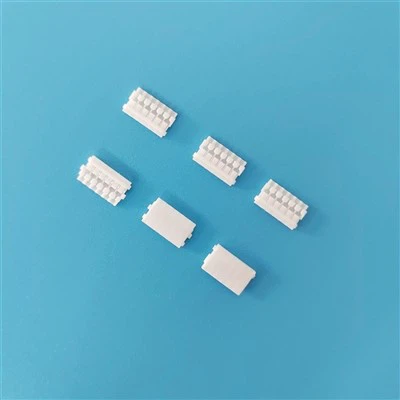

Hey there! As a supplier of 1.25mm pitch products, I often get asked about the difference between 1.25mm pitch and 0.8mm pitch. So, I thought I'd write this blog to clear things up and give you a better understanding of these two pitch sizes.
What is Pitch?
First off, let's quickly define what pitch means. In the world of electronics, pitch refers to the distance between the centers of adjacent pins or contacts on a connector or component. It's a crucial measurement because it determines how well a connector will fit with other parts and how much space it will take up on a circuit board.
1.25mm Pitch
Let's start with 1.25mm pitch. This is a relatively common pitch size, and it has a lot going for it. One of the main advantages of 1.25mm pitch is its balance between size and performance. It's not too small, which means it's easier to handle during assembly. You don't need super - precise equipment to work with 1.25mm pitch connectors.
For example, if you're working on a project where you need to connect multiple components on a circuit board, 1.25mm pitch connectors can be a great choice. They offer a good amount of space between pins, which reduces the risk of short - circuits. This is especially important in high - power applications where a short circuit could cause serious damage.
Another benefit of 1.25mm pitch is its versatility. It can be used in a wide range of applications, from consumer electronics like smartphones and tablets to industrial equipment. At our company, we offer a variety of 1.25mm pitch products. You can check out some of our alternatives, like Alternative 53261 - 0271,53261 - 0371,53261 - 0471,53261 - 0571,53261 - 0671,53261 - 0771,53261 - 0871,53261 - 0971,53261 - 1071,53261 - 1171,53261 - 1271,53261 - 1371,53261 - 1471,53261 - 1571,53261 - 1671,Housing Terminal DIP SMT Wafer. These products are designed to meet different needs and specifications.
We also have Alternative 205957 - 0271,205957 - 0371,205957 - 0471,205957 - 0571,205957 - 0671,205957 - 0771,205957 - 0871,205957 - 0971,205957 - 1071,205957 - 1171,205957 - 1271,205957 - 1371,205957 - 1471,205957 - 1571,205957 - 1671,Rubber Shell Terminal 1.25mm Pin Holder Spot, which are great for applications that require a bit more flexibility and protection. And if you're looking for a specific type of connector, Alternative GHDR - 14V - S - 1 might be just what you need.


0.8mm Pitch
Now, let's talk about 0.8mm pitch. This pitch size is smaller than 1.25mm pitch, and it's often used in applications where space is at a premium. In today's world, where electronic devices are getting smaller and smaller, 0.8mm pitch connectors are becoming more and more popular.
One of the biggest advantages of 0.8mm pitch is its ability to save space on a circuit board. If you're designing a compact device, like a smartwatch or a small - form - factor computer, 0.8mm pitch connectors can help you fit more components into a smaller area.
However, working with 0.8mm pitch connectors also comes with some challenges. Because the pins are closer together, it requires more precise assembly techniques. You need specialized equipment and highly skilled technicians to ensure that the connectors are properly installed without causing short - circuits.
Key Differences
- Size and Space: The most obvious difference between 1.25mm pitch and 0.8mm pitch is the size. 1.25mm pitch connectors take up more space on a circuit board compared to 0.8mm pitch connectors. If you have limited space, 0.8mm pitch might be the better choice. But if space isn't a major concern, 1.25mm pitch offers more room for error during assembly.
- Assembly Difficulty: As mentioned earlier, 0.8mm pitch connectors are more difficult to assemble. The closer pin spacing requires more precise alignment and soldering. On the other hand, 1.25mm pitch connectors are relatively easier to handle, making them a good option for projects with less experienced assemblers.
- Application Suitability: 1.25mm pitch is suitable for a wide range of applications, from general - purpose electronics to industrial equipment. 0.8mm pitch, on the other hand, is mainly used in applications where miniaturization is a key requirement, such as portable devices and high - density circuit boards.
Which One Should You Choose?
The choice between 1.25mm pitch and 0.8mm pitch depends on your specific needs. If you're working on a project where space is tight and you have access to precise assembly equipment and skilled personnel, 0.8mm pitch might be the way to go. But if you're looking for a more forgiving option that's easier to work with and suitable for a variety of applications, 1.25mm pitch is a great choice.
As a 1.25mm pitch supplier, I'm confident that our products can meet your needs. Whether you're a hobbyist working on a small project or a large - scale manufacturer, we have the right 1.25mm pitch products for you. If you're interested in learning more or want to discuss your specific requirements, feel free to reach out to us. We're here to help you make the best choice for your project.
References
- Smith, J. "An Introduction to Electronic Connector Pitches." Electronics Today, 2020.
- Johnson, M. "The Impact of Pitch Size on Circuit Board Design." Journal of Electronic Engineering, 2019.